How is your relationship with Not Knowing?

"Not Knowing is most intimate..." - Zen saying

Mavericks-Labyrinth-with-sky1-300x168.jpg

This is a note for you. You are such a good student, when there's a teacher standing in front of the class, and other students surrounding you, all learning to do the same things. You are a stellar worker, always taking responsibility for your job, above and beyond the call of duty. You take instructions quickly, correct your mistakes diligently, and do everything you can to get along with others. You are smart, capable, successful, but still feel there's something missing from your life, even though you can't quite name it.

So what is it? What is that missing thing?

I don't know.

But I'm willing to bet that your relationship with Not Knowing could use a little tune-up. A little checking in and refamiliarizing. You see, each of us was born in a state of perfect Not Knowing. The first several years of our lives were filled with the joy, awe, and wonder of discovering, playing, experimenting, failing, and doing it all over again every single moment. This is how we learned to walk, talk, and explore the world around us. There was tremendous accumulation during this time, but the overwhelming majority of space was occupied with Not Knowing, and being perfectly content with that.

Then we acquired language, and experience, and started going to school, where we learned to correct our mistakes diligently, take instructions quickly, and get along with others.

Those skills served us in advancing through lots more school, in getting a job, and then learning the ways of the business and professional worlds.

Somewhere along the way, all of that accumulation began to take up much more space than Not Knowing. In fact, we may not even remember the last time we did something for the first time.

So right now you may be wondering, "How does Not Knowing actually solve a problem I'm experiencing in my life?".

Consider how your life might be different if you reclaimed the fun of it. Not having a reason, but just doing it - you know, whatever that thing is that you've always wanted to do or try. Letting go of what experience tells you, and embracing the fresh innocence of the present moment.  Better yet, just existing without judgment.

If any of these sound scary or crazy, it may just be that you've been out of practice at Not Knowing.

And how do you practice Not Knowing? Well, not by fixing it or solving it. Not by hunting for an answer, or coming up with a plan.

But by consciously being there. And watching attentively while you are there.

Last night I went to my first ever hula dancing class. I had never dreamt of hula before, but I saw a performance locally that really inspired me, and then I found out there was a community class offered right in my town.

So I showed up.

There was a lot to learn. The teacher started out slowly, showing us the basic steps, then putting a few of them together into a simple first dance. Then we newbies were sent to the back of the classroom and were told to fake our way along with the more experienced dancers as they rehearsed songs they already knew.

I got to experience myself in the moment of Not Knowing, and to see how I stayed with myself. Now I am at a point where I can see this as a precious gift. But I also know that not so long ago, this was an edge I very carefully avoided, constructing my life so that I would never be in that position of Not Knowing.

How do you react when you are put in the space of Not Knowing?

Do you ask for more information?

Do you look around for someone who looks like they know what they're doing, then copy?

Do you sit out and wait until next time, when you'll definitely know more and do better?

Do you just keep moving, doing what you can, trusting that this is exactly where you should be?

Do you compare what you can do now to what others around you are doing, trying to figure out what's wrong?

All of these are possible ways to relate to Not Knowing.

And all of these responses - if we are able to observe them in ourselves - hold the possibility to bring us closer to knowing ourselves. Closer to becoming intimate with Not Knowing. And more grateful for being exactly where we are in any given moment.

So that is the gift of any brand new experience, whether you enter it by choice, opportunity, or crisis.

In one form or another, all of my work is an opportunity for you to experience yourself in relationship with Not Knowing. I hold open the space for you to experience how you are as you navigate this unfamiliar territory.

This fall, I'm offering you an expansive yet gentle way to become more intimate with your own space of Not Knowing. It's an oceanside retreat with me and a circle of 6 participants, called "Beyond Knowing: Many Paths to the Present Moment."

We will learn from the teachers in nature - the ocean, the sky, the birds, the trees, the sand. We will also learn from approaching and entering various portals to the present moment, which is always fresh and alive with Not Knowing. We will discover what arises when we clear our attachments to thoughts, align our mind-body-soul, and allow our innate expressions to find a voice. We will create a safe space together where we can touch the space of Not Knowing, with gentleness and firmness, full participation, mutual support, no judgment, no force, and no extra.

You will take home tools that you can continue to practice in your daily life, each time you come in contact with the beauty and terror of Not Knowing. You will also take home artifacts from your unique expressions created in the setting of the circle of support provided during the retreat, reminding you of your heart's truth, and your magical reserves of resilience. You will also have the experience - carried in every cell of your body - of having become more familiar, more intimate with Not Knowing.

You can learn all the details about the retreat here.
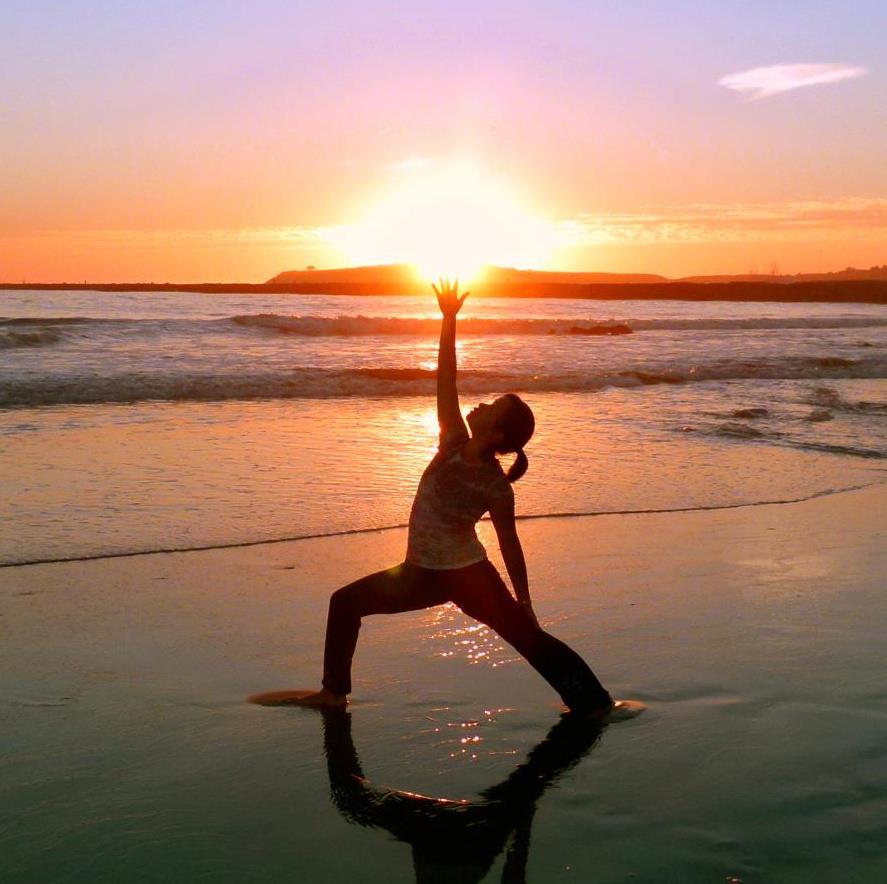
Live Your Medicine

Lisa Pillar Point FB profile reverse warrior The Native American tradition speaks of each person's Original Medicine - that set of gifts that only you can offer the world with your particular life. I've always felt there was such a finality to the phrase "Original Medicine" - like I had to define the one thing I was here to do, or it would be lost forever.
No pressure!

This feeling would ignite the achiever in me, who would scramble to come up with a name, a brand, a package, a business, something very "put-together" that would create an image of how well I knew my Life's Purpose.

I've been doing some version of that for most of my life. But recently I've begun to discover a process I find much more alive, much more healing, much more in alignment with my own sense of unconditional wholeness. I call it "Live Your Medicine." It is the practice of asking, "What time is it now, for me?". It involves listening for what holds the most fear for me in this moment. And then summoning the courage to take action toward that in one small way. Again and again, revisiting and refreshing with each present moment.

It is reminiscent of Eleanor Roosevelt's words:

"You gain strength, courage, and confidence by every experience in which you really stop to look fear in the face. You are able to say to yourself, 'I have lived through this horror. I can take the next thing that comes along.' You must do the thing you think you cannot do.”

How often do we actually avoid - quite skillfully - the things that spark fear inside us? How often do we explain away these avoidances with elaborate theories, often quite impressive in their defense of our own status quo?

"Live Your Medicine" captures my emerging discovery that the true healing experiences for me happen whenever I do something that is utterly frightening to my mind's unquestioned beliefs. "Live Your Medicine" is an invitation to search inside yourself to find your edge, and to live in a way that develops your courage, rather than reinforcing old patterns, no matter how comfortable they seem.

For example, each morning for most of my life, I would begin with a "To Do" list - my responsibilities and things to get done. There was no reason for me to get out of bed beyond that list. It served as my purpose. There was no rhythm other than the methodical ticking off of items, showing up for scheduled activities, and getting through things.

Everything in my life changed when I made one seemingly small shift: I began my days differently. Instead of hopping out of bed and beginning to run after my "responsibilities" dutifully, I stepped off my bed and sat in silence, looking out a window at the sequoia tree stretching tall in front of it. I started with five minutes. I did yoga, not when the yoga studio scheduled a class, but when I needed it - sometimes first thing in the morning - and for the length of time my body required it - sometimes only twenty minutes.

Since then, I have maintained a practice of beginning my days with rituals that ground me in my connection to breath, body, and the earth. I am currently blessed with the situation of living just fifty steps from the beach. Most mornings I make the walk out to the bluff, and down to the sand where the birds pace along the water's edge. I wake up gradually, following the pace of the sun's creeping over the fog-covered hills to reveal the glistening surface of the ocean.

I notice, though, that even this ritual can drift into feeling of an "assignment" I give myself. I can fall back into a pattern of giving myself a job - even if that "job" is to start my day more kindly. My practice can harden into a set of rules that I must follow, or else be judged as something less than acceptable to myself. Not very kind!

My mind can turn any practice into a "To Do". It's just a repetitive pattern - a habit that was practiced for many years, and reinforced without questioning.

So my medicine is to "do the thing I think I cannot do". To be attentive to what that thing is, in this moment. And then do it.

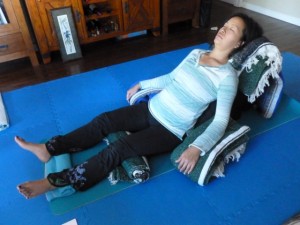
I recently learned some simple restorative yoga poses from a friend. No need for the fancy bolsters, blocks, straps, and blankets that I've used in yoga studios. I can use pillows, blankets, and whatever else I have available. The experience is like floating - like my entire body is being supported, almost suspended, without any effort from my muscles. It's like being in water, without having to move at all.

And it's a totally ridiculous way to start the day! Which is why it's my medicine. Living MY medicine, at this particular point in my life, means having the audacity to begin my day by going into a state of complete surrender and relaxation. As if there is nothing to do, nothing to conquer, nowhere to be.

This is what living my medicine looks like for me, right now:

Restorative Yoga Lisa While my body floats in the feeling of being totally supported, my mind rests. It cannot feel fear in this moment of rest. And each moment I spend here, I train in courage. I look fear in the face - the fear that whispers a "To Do" list in my ear - and I do nothing anyway.
What's YOUR medicine right now? What time is it now for YOU?

Photo credits: Top - Randy Bales. Bottom - Lydia Puhak.

Trying To Squeeze Blood From A Turnip and The Power of No Force

Part of a series exploring each of the Breema Nine Principles of Harmony turnips001

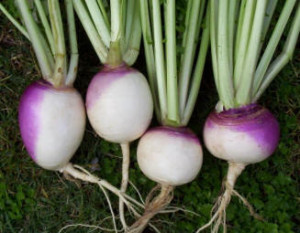
Trying to squeeze blood from a turnip is a lot like being at war with reality.

What are the ways we use force against what is, in an attempt to make things the way we think (and thought is the key word here) they should be?

Does it ever really work? And at what price? When we use force, do we even know that our sanity, our inner peace, our body, exists? Or do we only see the blood we want so desperately to come from the turnip, or whatever we are applying force to?

If we see clearly, we first begin to recognize that we are not getting the blood we want, despite all the effort. If we continue to look, we might be able to recognize that there's a turnip involved, a turnip that is quite innocent, being a turnip. It has no blood to give. It's just being squeezed, and squeezed some more, harder and harder. You (the one who is squeezing) keep getting more frustrated, but the turnip is not doing anything different. Surprise, surprise, it's still a turnip! Your squeezing, your effort, your frustration, your attempts, have done absolutely nothing to change that.

The turnip seems puzzled. It seems to ask, "Why are you angry at me for being a turnip? Why are you frustrated that there's no blood in me to give? You are getting everything you possibly can from me, because I am a turnip!"

If we look really deeply, we might then see that it's not the turnip who has the problem. We are, at some level, insane for being attached to an outcome that does not - cannot - exist. Until we see all of this clearly there is no way we will let go of our grip on the turnip. We will keep squeezing and squeezing, until our hand gives out or our frustration gets the better of us. The turnip won't yield any blood, and it probably won't even change shape. But what will we be left with? A sore hand, and a broken spirit. Time spent in useless frustration, curses thrown at the luck we were dealt. And no blood.

Not a very fulfilling way to pass the time. Or a very good way to use the strength in your hands.

Working with the body, I've noticed that there is power in the hand when it receives. When you align your entire body, placing your hand in a position where, when it simply receives the weight of your body, it carries the entire universe in its palm. There is no effort in that moment. There is intention and presence in positioning your body to be able to receive. But once those intentions and alignments are in place, the rest is effortless. There is No Force.

However, there is tremendous power. In the moment of No Force, there is space for the power to heal, to release, to discover, to transform. When we let go of force, we merge with reality. Reality is kind, if we allow it to show us what we need to see.

No Force is a way to practice kindness toward yourself. The beneficiaries of No Force will extend beyond you, but if you need a reason to begin, begin with what is kind to yourself.

Precision, Gentleness, and Letting Go

Braid closeup In The Wisdom of No Escape, there's a chapter where Pema Chodron talks about three useful qualities for life and for meditation: precision, gentleness, and letting go.


I've been consciously living with the nine principles of Breema lately, and I've noticed how precision, gentleness, and letting go are a useful way to greet any practice, old or new.

For example, one of the Breema principles is "No Judgment."

When you begin to study and practice "No Judgment", the first thing you notice is how much judgment is in your mind already.

"No Judgment" brings your attention first to the judgment that's there. Which means, you begin to identify judgment as judgment. That's precision. You may notice as a new student of something, you like to be very precise. So every time you see your mind judging, you say to yourself, "Damn it, I'm judging again! Why am I so judgmental? I need to stop judging so much." And you feel the assault on yourself beginning to happen.

This is the moment when gentleness can enter in. You have an opportunity to practice gentleness, or to continue the assault. Gentleness gives you the opportunity to take a different attitude toward yourself, even as you see, with precision, what is going on. Gentleness encourages you to just see, without extra attacks or criticism or labeling. In other words, no need to judge your judgment. Be gentle with yourself as you begin to see clearly. Just see what is, with no extra.

Letting go is the final practice, and it is the result of practicing both precision and gentleness. Letting go is not something to achieve or do, but is a natural unfolding of both precision and gentleness practiced together. When you play with these qualities of precision and gentleness, dance with them back and forth, and then gradually see that they are both happening all at once, there is a feeling of letting go. Neither precision nor gentleness has to "win". There is no final state to achieve. There is no superior way to be.

Letting go is a sensation of relief. That it's not all such a big deal. That we definitely need to practice, but part of the practice is also to let it all go. Letting go is not a "Forget about trying, I'll just give up" kind of feeling, but rather a smiling recognition that no one needs to win or lose, not even the more or less enlightened parts of your own mind. It's a kind of relaxation into the present, a return to what is, and a feeling that our attached thoughts are not who we are. A knowing that our true essence is something much lighter, and also more timeless than any thought or practice.

Living With A Perfectionist In Your House

I am a recovering perfectionist. I’ve been practicing various antidotes to perfectionism quite consciously for about three years now. That makes me – the real me, the innocently imperfect me – about three years old. I’m walking, I’m talking, I’m eating with my plastic miniature utensils, insisting that I’m a big girl now. But the real big girl in the house – the house of my mind, my body, and my soul – is Miss Perfectionist. She is the one who grew up inside my house, the house of me. She became the big one without my knowing it. She got all the praise, all the money, all the polite smiling conversations at cocktail parties, all the “wow”s and “ooh”s and “aah”s, all the framed diplomas and plaques on the wall. She was surrounded by people she kept at an arm’s length distance, so they wouldn’t touch anything close to her.

She thought she liked it that way. She thought she preferred it that way, because her attention could be focused on making her hair perfect, her face perfect, her nails perfect, her shoes perfect, her outfits perfect, anything that would attract the attention of perfection praisers, which seemed to be everywhere.

Miss Perfectionist was so busy doing the things she defined as perfection – which always involved something other than the way things were – that she ignored the real me, who by the way, happened to own the house the whole time.

Haunted House

As I write this, I’m fresh from peeling away another layer of awareness of how Miss Perfectionist still lurks, like a creepy roommate, in the house of me. I’m also more aware of the real me, that three-year-old who has just gotten her legs, who has registered  the definite feeling of walking, moving one foot in front of another, exploring this amazing thing called existence.

And I’m not willing to ignore that three-year-old, at this magical time of her life. I’m not willing to yell at her, throw her out on the porch in her nightgown, telling her she is wrong and worthless as she is. I’m not willing to have her mentored by Miss Perfectionist.

You see, Miss Perfectionist is not very supportive in moments that require vulnerability, moments that require the raw courage to step into unknown, unfelt territory. Miss Perfectionist, in fact, hates those kinds of moments. Miss Perfectionist much prefers the mind’s activity of projecting into the future, comparing the present moment to the imagined future, and listing how it doesn’t measure up: "It’s not good enough, it’s not important enough, it’s not professional enough". The list is usually much longer than three items. The list of “not”s can take over an entire conversation, an entire house, an entire life.

I see today that Miss Perfectionist is simply afraid. She is frozen with fear that someone might actually see the whole house she lives in. That there are little tiny children in there, still crawling around, learning to walk, falling down all the time in the process. That would be so humiliating to Miss Perfectionist! And she doesn’t believe she can survive that humiliation.

I see her – I see me. I see the real me beginning to live life, in the tender state of being three, being open to all possibilities and ripe with the potential of one whole life, surrendered to the present moment.

I see me, and I choose to be gentle with me. I choose to take the small steps of a three-year-old, knowing with total confidence that these steps are the only ones I – the real me - can take right now. And it’s enough.

Miss Perfectionist can have her own room in this house, but she does not own it. We are living here together, and there is space for both of us to exist in harmony. For now.

Photo credit: http://doubtfulnews.com/2012/10/buying-a-haunted-house-there-may-be-logical-reasons-why-thats-not-a-good-idea/

Leaning in…to what?

woman leaning illustration There's going to be some talk about leaning in. I’d like to speak about “leaning in” from the perspective of a woman who learned the men’s rules and did pretty well for awhile. I picked up all the cues about how I was supposed to behave, what I was supposed to do to play the game, how I could win. I earned a seat at the boardroom table, surrounded by men. I am grateful for the doors that were opened for me, when I behaved a lot like a successful man.

I rode the bus for a few rounds before I got off and started the process of sitting in front of the blank page, making up my own game, creating my own rules, and teaching myself a whole new way of "leaning in".

When we talk about “leaning in”, we have to talk about what that really means for individuals. To me, “leaning in” is about going toward the places that scare you. The real question is, “What scares you?” Most of us are living in remote places that are carefully designed to be far out of reach from what really scares us. We have concocted our plans based on meticulous avoidance of everything that really scares us.

We believe that this construction project actually spares us the feeling of being scared, but it follows us. It never leaves us. It camps out in dark corners inside us. We dart, we duck, we hide, we layer on coats of paint and makeup and accessories and postures that we think – hope – will cover it up. But it plagues us.

We seek relief, but we also secretly believe we’ll never find it. We think this is as good as it gets, so we keep pointing in the same direction.

So what are we leaning into?

cliff

Are we leaning into the things we think will make our fears go away? Will “ambition” lead us to a place where we will finally be safe? Will “success” in the workplace, attaining a title of power, actually make us feel empowered? Will “winning” at the men’s game finally make us feel like we’ve won our battle with fear?

Maybe.

But until we do the work of facing what really scares us, looking at it, pointing toward it, touching it, getting close to it, we won’t know. We will only be leaning toward some collective crusade that starts from outer appearances and tries to solve those problems cosmetically.

We won’t be looking inside ourselves to ask, “Where do I need to lean in?” Is it really ambition to step up in the workplace? Maybe. But it could be just as ambitious for me to do exactly the thing I think I cannot do – which may be giving up “ambition” of a certain kind, and going toward a whole different flavor of success, which looks a lot like failure to some people.

Ambition might look like a lot of different things, but we can’t know just by looking. We need to feel our own experience in order to know.

To me, leaning in feels like courage. Leaning in feels like facing the thing that you’ve avoided for so long. Leaning in feels like following the path of courage no matter what it may look like on the outside, no matter what rules need to be followed or broken. Leaning in feels like building strength that does not come from what other people say, or what titles I am granted. Leaning in is really leaning inward, to fill up the well of knowing without needing systems to change, or other people to change. Leaning in is true power.

But please don’t take my word for it. Lean in for yourself and find out.

Image credits: Woman - http://illustrationsource.com. Man - http://liberadio.com

Touching The Place of Enough

My friend Lydia Puhak, coach and creator of The Sensitive Idealist, recently interviewed me as part of her series on Self-Care. You can listen to our sweet conversation here. Funny how sometimes the most important lessons we learn are the quiet, gradual processes that unfold out of necessity.

That would be the case with me and my learning about self-care.

Back in late 2010, I burst on to the scene with my "5 Principles of Self-Care for Caring Professionals". I wrote a blog post, hosted a series of calls, then turned the material into an online course.

And then I left it at that.

I got "busy" with the work of living these principles in my own life. I came face-to-face with my own version of workaholism, and started on the path of recovery. I unplugged from the computer and went outside. A lot.

I got back in touch with a slower way of doing things - growing a garden, cooking meals instead of heating up trays of food, forming more real relationships in the real world.

The biggest (and smallest) change I've remained committed to during this entire almost-three-year period is how I start my day.

Before 2010, I was a slave to my Blackberry, not because I was working such an "important" job that I needed to be available at all times, but out of habit. A habit that developed initially out of a need to feel important, and that continued because I never considered other options.

I began each day by waking up to the alarm on my Blackberry, and immediately checking my email.

I experienced a slight deflation in my chest if there were no new messages. I quickly found out that I could fix that by subscribing to more newsletters.

I felt a rush of adrenaline when there was evidence of "things to do" - meaning, when I got email messages that required me to respond.

My whole life was a series of transactions. My motivation for getting out of bed in the morning was my list of "to do"s.

I was very skilled at this game, so I never ran out of things to do. My mind always found a way to create more.

What was missing in this way of life was a felt sense of enough.

When your feeling of importance comes from what other people ask you to do, or how busy you are on a given day, there is no endpoint to the doing. More is always better, because more to do equals more feelings of worthiness.

Until the "to do" list goes away.

Or when your ability to do goes away.

So, as you might imagine from a benevolent Universe, I was given the gift of not being able to do any more.

My body reached its limit.

I was not hospitalized or injured, but I was in pain. Immobilizing physical pain that definitely did not match my vision of "living my dream".

I met many teachers from that moment on. Teachers who encouraged me to speak the truth of my heart in front of strangers. Teachers who showed me a whole repertoire of sounds that I had never made before. Teachers who had broken the prison bars of their own minds, and freed themselves from deep-rooted childhood beliefs. Teachers who pointed me to the wisdom of my own inner authority above anyone else's teaching. Teachers who taught me how to sit and stand and sleep in ways that preserve the natural anatomy of the spine. Teachers who embody grace and loving kindness in the practice of their art. And the teachers in every moment of everyday life.

But the linchpin - the common thread, the consistent practice - throughout all of this learning has been paying attention to how I start my day.

[singlepic id=490 w=320 h=240 float=center]

I no longer read my email in the morning. I no longer consult a list of things to do.

I wake up and I give thanks. Either silently or out loud, I open my eyes and give thanks for this day.

I then dedicate at least one full hour to my breath and body. Either on the beach or in my home studio, I visit the place within me from which all is created. I breathe and move consciously. I feel my breath move through my body. I treat my body with kindness and gentleness. I use this space and time to listen carefully.

And I sit. I sit with whatever arises on a given day. Sometimes I notice my mind is very active, wanting to insert thoughts throughout my practice. Sometimes I notice that I can descend into the waves of feeling, watching my breath make its subtle patterns throughout my body. Other times I am simply grateful for the practice, and nothing more "significant" occurs.

When I feel rushed or somehow skip this practice, I notice. I feel heavier, more burdened, plagued by a sense that I am not doing enough, or that there is not enough of something happening in my life. My mind gets snagged in a knot of insufficiencies, buried in thoughts that I need to fix or do or say or be more.

This practice is quiet and generally unnoticed by anyone but me. It is not something I teach to others, not something I have packaged into a product.

And it is my core. It is my way of touching the place from which all of life arises. Call it self-care, call it meditation, call it yoga, call it space.

Call it nothing at all, but know that when you find your core, you will want it as your constant companion, your reminder of what's true and real, your own place that no one can see or hear or feel but you.

And that is enough.